English
  cn
cn
When selecting tubing for a fluid control application, the first specifications engineers usually check are outside diameter, inside diameter, and wall thickness. These dimensions determine whether a tube will fit the intended connection, provide sufficient internal flow space, and offer the physical characteristics required by the application. Choosing by nominal size alone can easily result in a mismatch between the tubing and the equipment.
Tubings PVC provides a range of transparent tubing sizes in both imperial and metric dimensions, giving engineers and purchasing teams more flexibility when matching tubing to existing equipment. The available products cover outside diameters from 2.4 mm to 14.3 mm, with several combinations of inside diameter and wall thickness.
For applications involving fluid handling, medical equipment, analytical instruments, diagnostics, or other precision systems, understanding these dimensions is more useful than simply selecting the largest or smallest available tube.
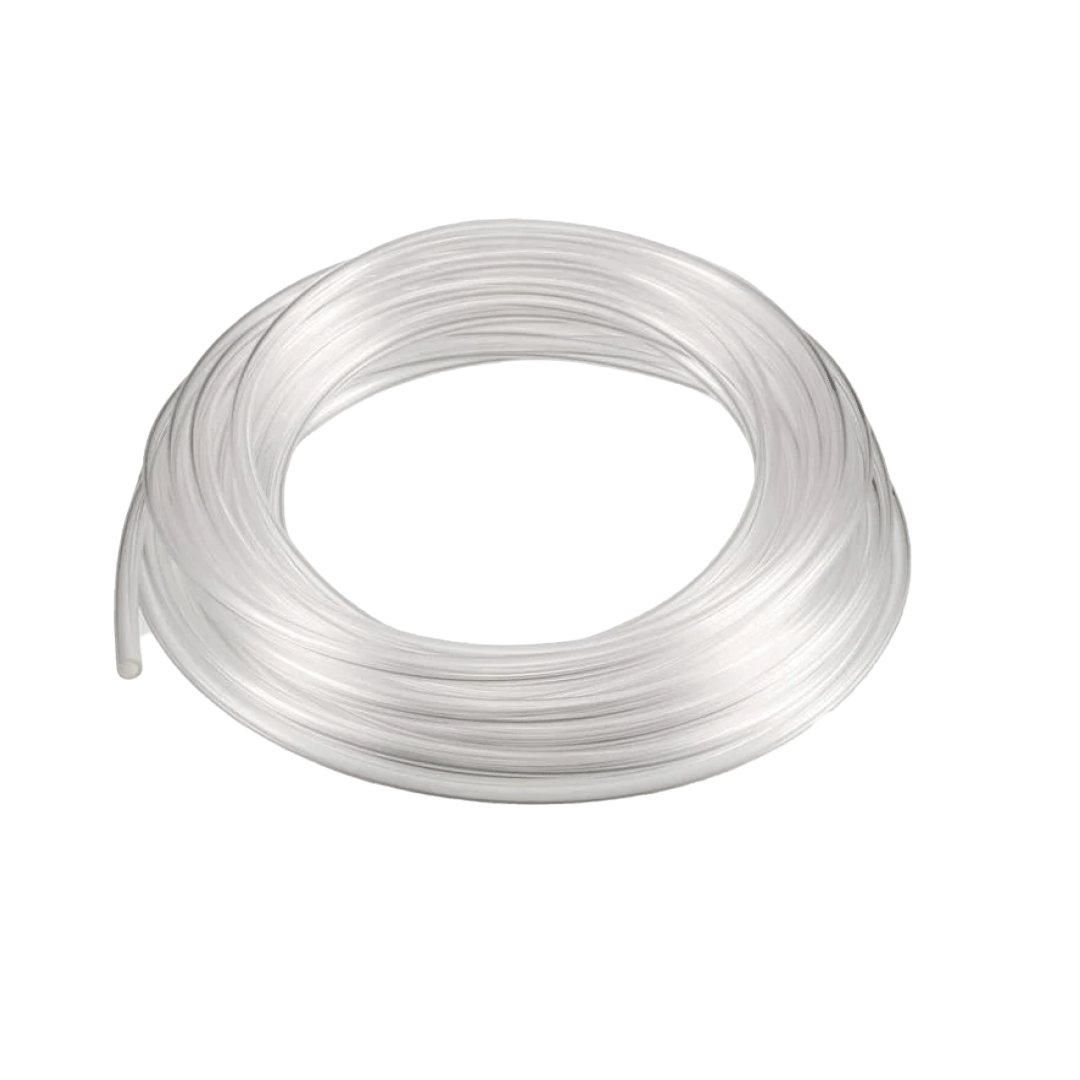
OD: The Outside Diameter of PVC Tubing
Outside diameter, commonly abbreviated as OD, is the measurement across the outside of the tube from one outer edge to the opposite edge.
OD is particularly important when the tubing must fit into a connector, clamp, fitting, guide, or equipment interface. Even when the internal flow requirement is suitable, an incorrect OD can prevent proper installation.
For example, the Tubings PVC range includes a 1/4-inch OD tube with a 1/8-inch ID and another 1/4-inch OD option with a 3/16-inch ID. Both have the same outside diameter, but their internal dimensions are different.
This distinction is important when selecting tubing for a specific connection. The fitting may require a particular OD, while the application simultaneously requires a certain internal passage.
The available OD options include:
- 3/32 inch / 2.4 mm
- 1/8 inch / 3.2 mm
- 5/32 inch / 4.0 mm
- 3/16 inch / 4.8 mm
- 7/32 inch / 5.6 mm
- 1/4 inch / 6.4 mm
- 5/16 inch / 7.9 mm
- 3/8 inch / 9.5 mm
- 7/16 inch / 11.1 mm
- 1/2 inch / 12.7 mm
- 9/16 inch / 14.3 mm
Having both imperial and metric references is useful when the tubing is being integrated into equipment designed around different measurement systems.
ID: The Internal Passage That Carries the Fluid
Inside diameter, or ID, describes the open passage through the center of the tubing. For fluid applications, this dimension directly affects the available flow area.
A larger ID generally provides more internal space for fluid movement, while a smaller ID may be appropriate where controlled flow or compact tubing is required. However, ID should always be considered together with the application's flow requirements rather than selected independently.
For example, the product range includes tubing with a 1/32-inch / 0.8 mm ID, 1/16-inch / 1.6 mm ID, 3/32-inch / 2.4 mm ID, 1/8-inch / 3.2 mm ID, 5/32-inch / 4.0 mm ID, 3/16-inch / 4.8 mm ID, 1/4-inch / 6.4 mm ID, 5/16-inch / 7.9 mm ID, and 3/8-inch / 9.5 mm ID.
When replacing an existing tube, measuring the original ID can help avoid an unexpected change in flow characteristics. When designing a new system, engineers should instead work backward from the required flow rate, pressure conditions, fluid properties, and connection dimensions.
Wall Thickness: The Difference Between OD and ID
Wall thickness is the material thickness between the outside surface and the inside passage of the tube. For a simple round tube, it is related to OD and ID by the following relationship:
Wall thickness = (OD − ID) ÷ 2
This makes wall thickness easy to calculate when OD and ID are known, but manufacturers may still specify it directly because it is an important production and performance parameter.
Consider two tubing options with the same 1/2-inch OD. One has a 1/4-inch ID and a 1/8-inch wall thickness, while another has a 5/16-inch ID and a 3/32-inch wall thickness. Although their external dimensions are the same, their internal passages and material thicknesses are different.
Wall thickness can influence flexibility, dimensional stability, mechanical resistance, and how the tube behaves when subjected to compression. Therefore, selecting tubing solely by OD can overlook an important part of the design.
How OD, ID and Wall Thickness Work Together
OD, ID, and wall thickness should be evaluated as a combination.
If the OD needs to remain fixed because of the connection, increasing the ID necessarily reduces the wall thickness. Conversely, a smaller ID at the same OD results in a thicker wall.
This relationship can be seen throughout the Tubings PVC selection range. For example:
| OD | ID | Wall Thickness | Length |
|---|---|---|---|
| 2.4 mm | 0.8 mm | 0.8 mm | 30 m/roll |
| 3.2 mm | 1.6 mm | 0.8 mm | 30 m/roll |
| 4.8 mm | 1.6 mm | 1.6 mm | 30 m/roll |
| 6.4 mm | 3.2 mm | 1.6 mm | 30 m/roll |
| 7.9 mm | 4.8 mm | 1.6 mm | 30 m/roll |
| 9.5 mm | 6.4 mm | 1.6 mm | 15 m/roll |
| 12.7 mm | 6.4 mm | 3.2 mm | 15 m/roll |
| 14.3 mm | 9.5 mm | 2.4 mm | 15 m/roll |
The table shows why a complete dimensional specification is more useful than a single size description.
Choosing Between Imperial and Metric Dimensions
Many equipment systems use either imperial or metric dimensions, and tubing selection needs to account for the actual connection standard.
For international projects, it is helpful to keep both dimensions available during procurement. A tube described only as 1/4 inch may not provide enough information for someone working with metric equipment unless the corresponding metric measurement is also provided.
The product range supplies imperial and metric OD and ID values together. This makes it easier to compare tubing requirements when equipment documentation, fittings, and manufacturing specifications use different units.
However, nominal conversions should not be treated as interchangeable fitting specifications. Engineers should verify the actual required dimensions before ordering, particularly where the tubing connects directly to precision components.
Hardness Also Matters After Size Is Confirmed
Dimensional selection is only part of the process. Once the correct OD, ID, and wall thickness have been identified, tubing hardness should also be considered.
The product is available in two material selections: PV-01 with a typical hardness of 65A and PV-02 with a typical hardness of 55A.
The two selections also show different typical laboratory results for tensile strength, elongation, tear strength, and compression. PV-01 has a reported tensile strength of 13 MPa, elongation of 330%, and tear strength of 30 kN/m. PV-02 has a tensile strength of 10 MPa, elongation of 400%, and tear strength of 22 kN/m.
These values are useful when comparing material behavior, but they are identified as typical laboratory test results rather than final product specifications. Final selection should therefore be based on the actual requirements of the application.
Consider the Tubing Length
Tubing length is another practical procurement detail that can be overlooked.
Most of the smaller sizes in the range are supplied in 30-meter rolls, while several larger sizes are supplied in 15-meter rolls. This difference matters when planning installation, production consumption, and inventory.
For equipment manufacturers, roll length can also affect how many connections or assemblies can be produced from one roll. Purchasing teams should consider the required tube length, cutting losses, and production schedule when calculating material requirements.
Why Transparent PVC Tubing Can Be Useful
The available tubing is transparent, which provides a practical advantage in applications where visual observation is useful.
Transparent tubing allows operators and technicians to observe the condition of the internal passage without immediately removing the tube. Depending on the application, this may help with checking fluid movement, identifying visible bubbles, or inspecting the general condition of the tubing.
The product is also described as pollutant-free, permeation resistant, non-oxidizing, and designed for long service life. These characteristics can be considered alongside dimensional requirements when evaluating tubing for fluid-control applications.
A Practical PVC Tubing Selection Process
For purchasing teams and engineers, a straightforward selection process can reduce errors.
First, identify the required connection dimension and determine whether the system uses imperial or metric measurements. Next, confirm the required OD. Then determine the appropriate ID based on the internal flow requirement and equipment design.
After that, check the resulting wall thickness and evaluate whether the tubing's mechanical properties and hardness are appropriate for the operating conditions. Finally, confirm roll length and availability before placing the order.
For sizes outside the listed range, additional options can be discussed with the supplier rather than assuming that a nearby nominal size will provide equivalent performance.
Choosing a Tubing Supplier for Precision Applications
Tubing is often only one component within a larger fluid-control system, so supplier capability matters when consistency and application support are important.
AIIBOOM develops precision fluid control components and customized solutions for medical devices, life sciences, diagnostics, analytical instrumentation, and environmental applications. The company operates R&D centers in Shenzhen, China, and Sendai, Japan, with manufacturing facilities in Dongguan, Guangdong, and Tongling, Anhui.
Its production infrastructure covers 20,000 m², supported by ISO 9001 and ISO 14001 management systems. With more than 20 years of industry experience, AIIBOOM combines product development, manufacturing, and engineering support for different fluid-control requirements.
For applications where tubing must integrate with connectors, valves, pumps, sensors, or other components, this broader technical capability can be useful when selecting dimensions and material characteristics.
Ultimately, choosing PVC tubing is not simply a matter of finding a tube that “looks close” to the required size. OD determines the external fit, ID determines the internal passage, and wall thickness affects the amount of material surrounding that passage. These three dimensions should be considered together with hardness, mechanical properties, length, and application conditions.
Tubings PVC offers multiple combinations of OD, ID, and wall thickness, including both imperial and metric dimensions, making it suitable for engineers who need more precise control over tubing selection. By checking the complete dimensional requirements before procurement, users can reduce fitting problems and select tubing that better matches the actual needs of their fluid-control system.